Magnesium glycinate in Australia: how much you’re really getting, and the top-rated options

Founder of Clean Green Safe
Magnesium glycinate has become one of the most searched-for supplements in Australia, and I completely understand why. It’s the form I’m asked about most, often by women who are taking it in the evening and wondering whether they’ve chosen well.
So let’s walk through it together: what magnesium glycinate actually is, how much magnesium you’re really getting, and how the products on Australian shelves compare.
What is magnesium glycinate?
Magnesium glycinate is magnesium bound to glycine, a small amino acid. You’ll also see it called magnesium bisglycinate, which simply means each magnesium is attached to two glycine molecules. On Australian labels the two names are used for the same thing, so if you’ve been comparing a “glycinate” with a “bisglycinate”, you’re comparing like with like.
Many people choose glycinate because they find it gentler on the stomach than some other forms, such as magnesium oxide.
How much magnesium is in magnesium glycinate?
This is the part that catches most people out. The big number on the front is usually the weight of the whole compound, magnesium and glycine together. Magnesium glycinate is only about 14% magnesium by weight, so 1,000 mg of magnesium glycinate gives you roughly 140 mg of magnesium.
Here are real examples from Australian labels:
- 1,134.8 mg of magnesium glycinate, equivalent to 160 mg of magnesium
- 1,063 mg of magnesium glycinate, equivalent to 150 mg of magnesium
- 750 mg of magnesium glycinate, equivalent to 150 mg of magnesium
Notice the last one. Products differ, which is why the line that matters is the one that says “equivalent to magnesium” or “elemental magnesium”, usually on the back. That’s the number to add up. Our free mineral calculator can work it out if your label doesn’t say.
How much magnesium do you need?
The NHMRC daily targets for adults, from food and supplements together, are:
- Women 19 to 30: 310 mg. Women 31 and over: 320 mg
- Men 19 to 30: 400 mg. Men 31 and over: 420 mg
- Pregnancy: 350 to 360 mg
There’s also an upper limit of 350 mg a day of magnesium from supplements. This limit is for supplements only, not food, because magnesium from food doesn’t cause the same problems. Going over it can cause loose stools and stomach upset. I’ve explained the targets in more detail in How much magnesium do you need?
If you take magnesium glycinate at night
Lots of people take magnesium glycinate in the evening, and many “sleep” or “night” formulas are built around it. If that’s you, here are a few things worth checking.
- The total magnesium. Night formulas often mix glycinate with citrate or other forms, so look for the total on the label.
- What else is in it. Passionflower, ashwagandha, glycine, saffron and vitamin B6 are common additions. That’s not a problem in itself, but it’s worth knowing what you’re taking.
- Vitamin B6. If your night formula, your multivitamin and your daytime magnesium all contain B6, the amounts add up. Read more in Is there vitamin B6 in your magnesium?
And if your sleep has been troubling you for a while, please do talk to your GP or pharmacist. There may be something we can help with beyond a supplement.
Top-rated magnesium glycinate in Australia
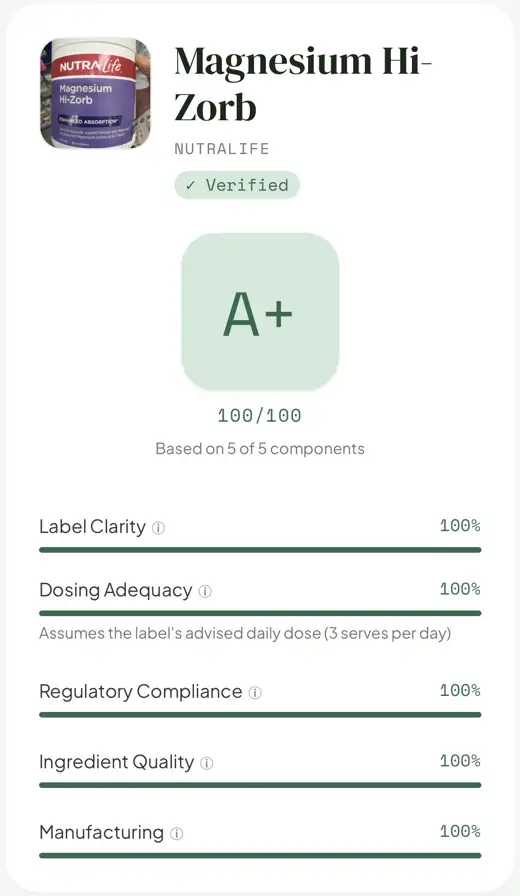
These are the magnesium glycinate products with the highest Clean Green Safe grades, all listed on the TGA register. Tap any one to see how it was scored.
Grades are based on five things: how clearly the label declares its ingredients, how the doses compare with Australian daily targets and upper limits, TGA register status, ingredient quality and manufacturing. No brand pays to be rated or listed. Grades update when labels change. Are you the sponsor of one of these products? Email hello@cleangreensafe.com.au with updated label details.
Who should check with a pharmacist first
- You have kidney disease, as your body may not clear magnesium as well.
- You take certain antibiotics, osteoporosis medicines or thyroid medicine. Magnesium can reduce how well these are absorbed, so they usually need to be taken a few hours apart.
- You’re pregnant or breastfeeding.
- You’re already taking more than one product that contains magnesium.
Questions people often ask
Is magnesium glycinate the same as magnesium bisglycinate?
Yes. Bisglycinate means each magnesium is attached to two glycine molecules, and Australian labels use both names for the same form. Compare products by the “equivalent to magnesium” figure, not the name.
Should I take magnesium glycinate at night?
You can take it at whatever time suits you, and many people choose the evening. If it upsets your stomach, try taking it with food. If you take antibiotics, osteoporosis medicines or thyroid medicine, ask your pharmacist how far apart to take them.
How much magnesium glycinate should I take?
Follow the directions on the label, and go by the magnesium amount rather than the glycinate weight. Keep your total magnesium from all supplements at or under 350 mg a day, unless your doctor has advised otherwise. Our mineral calculator can help you work it out.
Can I take magnesium glycinate with zinc?
Yes, and many products combine them. Just add up your zinc across everything you take and keep it under the 40 mg upper limit. Read more in How much zinc do you need a day?
Is magnesium glycinate better than magnesium oxide?
They’re different rather than better or worse. Magnesium oxide packs more magnesium into each tablet, about 60% by weight, while glycinate is about 14%. Some people find glycinate gentler on the stomach. What matters most is the magnesium amount and how well it suits you.
Can I take magnesium glycinate when pregnant?
Your magnesium needs are a little higher in pregnancy, at 350 to 360 mg a day from food and supplements. Please check with your doctor, midwife or pharmacist before starting any supplement, and look at whether your pregnancy multivitamin already contains magnesium.
Three simple checks you can do today
- Find the “equivalent to magnesium” figure on the back of each product you take.
- Add them up, and keep your total from supplements at or under 350 mg a day, unless your doctor has advised otherwise.
- Check every product for vitamin B6, especially night formulas and multivitamins.
If you’re unsure about anything, bring your labels to your local pharmacist. We’re always happy to look over them with you.
Cassie is a registered pharmacist, a parent and the founder of Clean Green Safe. With a background in Australian supplement regulation across the TGA, FSANZ and NHMRC, she built Clean Green Safe to help people understand what’s really in their supplements, and how it all adds up across everything they take.
How Clean Green Safe can help
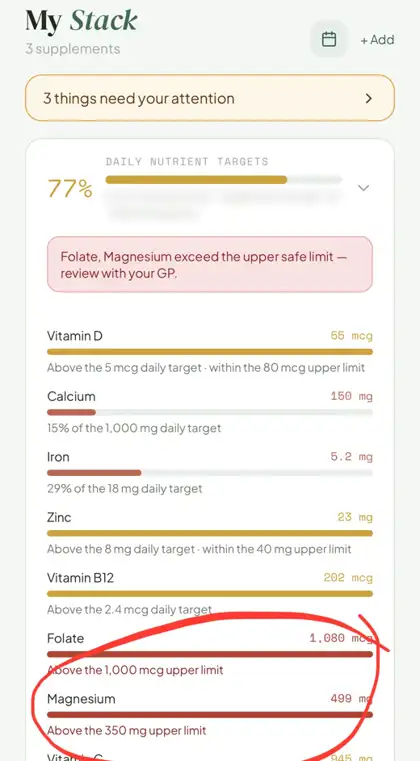
Scan your magnesium and Clean Green Safe reads the “equivalent to magnesium” figure for you, adds up the magnesium and vitamin B6 across everything you take, and checks your total against the 350 mg upper limit for supplements.
- STEP 1ScanScan the barcode or enter the AUST L number
- STEP 2CheckWe check it against the TGA register and Australian limits
- STEP 3SeeSee your grade and your daily totals across everything you take
Built by a registered pharmacist · Works in your phone’s browser